Canadian PM Carney unveils multibillion-dollar push to lower food costs
Carney has been under pressure from the opposition to lower prices of food and other essentials for lower-income people.
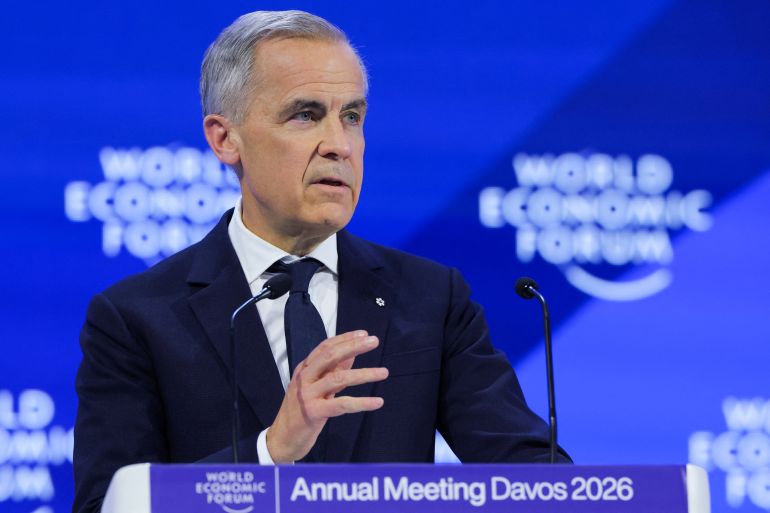
Canadian Prime Minister Mark Carney has announced a multibillion-dollar package as part of a series of measures aimed at lowering the costs of food and other essentials for low-income families.
On Monday, Carney announced a five-year 25 percent boost to the Goods and Services Tax (GST) credit that starts this year.
Recommended Stories
list of 4 items- list 1 of 4The ‘discombobulator’: Did US use ‘secret weapon’ in Maduro abduction?
- list 2 of 4Hundreds of thousands without power as US winter storm starts to wind down
- list 3 of 4EU probes Musk’s Grok AI feature over deepfakes of women, minors
- list 4 of 4Lula, Trump discuss ‘Board of Peace’, agree to meet in Washington: Brazil
The GST credit, which is being renamed the Canada Groceries and Essentials Benefit, will provide additional, significant support for more than 12 million Canadians, Carney said in a statement.
The government will also provide a one-time top-up equivalent to a 50 percent increase this year to eligible residents.
“We’re bringing in new measures to lower costs and make sure Canadians have the support they need now,” Carney said.
The measures would cost the government 3.1 billion Canadian dollars ($2.26bn) in the first year and between 1.3 billion Canadian dollars ($950m) and 1.8 billion Canadian dollars ($1.3bn) in each of the following four years, he told reporters at a news conference, according to the Reuters news agency.
While overall consumer price inflation in Canada has eased and came in at 2.4 percent for December, “food price inflation remains high due to global and domestic factors, including supply chain disruptions, higher US tariffs from the trade war and climate change/extreme weather”, Tony Stillo, director of Canada Economics at Oxford Economics, told XEn News.
The government is also setting aside 500 million Canadian dollars ($365m) from the Strategic Response Fund to help businesses address the costs of supply chain disruptions without passing those costs on to Canadians, and will create a 150 million Canadian dollar ($110m) Food Security Fund under the existing Regional Tariff Response Initiative for small and medium enterprises and the organisations that support them.
Changing landscape
“The global landscape is rapidly changing, leaving economies, businesses, and workers under a cloud of uncertainty. In response, Canada’s new government is focused on what we can control: building a stronger economy to make life more affordable for Canadians,” Carney said.
The new measures were unveiled on the day Parliament resumes after its winter break.
Opposition parties have urged Carney to reduce prices of daily goods, especially as sections of the economy have come under pressure from United States President Donald Trump, who has slapped 35 percent tariffs on the country as well as separate tariffs on steel, aluminium and lumber, leading to job losses in those sectors.
Over the weekend, Trump escalated his threats and said he would impose a 100 percent tariff on Canada if it makes a trade deal with China. Carney has been working on diversifying Canada’s exports away from the US, its biggest trading partner and to which nearly 80 percent of its exports went last year, including by increasing business with other markets like China.